
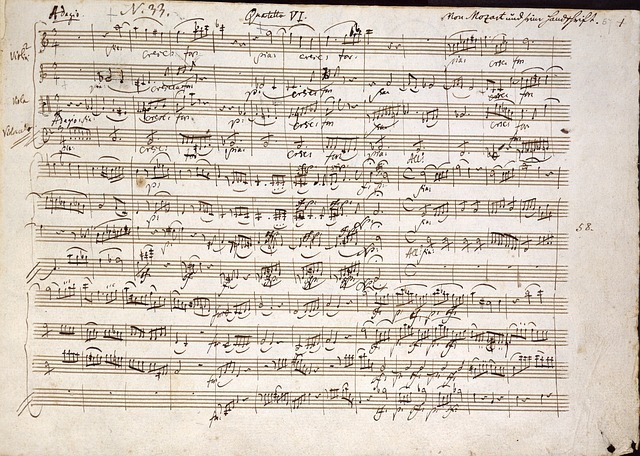
When a composer dies before completing a masterpiece, what happens to the music they leave behind? How do we, as listeners and performers, come to know and love these works that were never fully realized in their original form? In classical music, some of the most iconic compositions have been brought to life only through the efforts of other composers, arrangers, and scholars. These musical “reconstructions” raise an important question: what does it mean for a piece of music to be truly “complete”?
At our upcoming workshop on Mozart’s Requiem in January, we’ll explore one such iconic piece that was left unfinished at the time of its composer’s death. But Mozart’s Requiem is far from the only famous work to have undergone this process. In this post, we’ll explore three such cases to see how their completion gave us access to some of the most beloved and enduring works in classical music.
- Anton Bruckner’s Symphony No. 9 in D minor (WAB 109)
One of the most powerful and tragic examples of an unfinished masterpiece is Anton Bruckner’s Symphony No. 9, a work left incomplete at the time of the composer’s death in 1896. Bruckner famously struggled to finalize the symphony and left three versions of the Trio section of the second movement. He had started to plan a fourth movement to which he hoped to add a choral section. If Bruckner had lived to complete the finale, he would almost certainly have gone over the other movements and made adjustments.
After Bruckner’s death, the symphony was first performed in Vienna under conductor Ferdinand Löwe, who had made his own arrangement of the piece; Löwe published his altered version without comment, and this edition was long thought to be Bruckner’s original version. It wasn’t until 1931 that musicologist Robert Haas pointed out the differences between Löwe’s edition and Bruckner’s manuscript. Since then, different completions of Symphony No. 9 have been proposed, including versions with a choral finale that reflect Bruckner’s own sketches, and conductors take different approaches, sometimes performing only the three more complete movements and sometimes including a version of the finale.
The fact that this symphony has continued to be a staple in the orchestral and choral repertory, despite its incomplete state, speaks to the profound impact Bruckner’s music has had on audiences. While no completion can be said to fully capture Bruckner’s original intent, these posthumous reconstructions allow us to appreciate the symphony in a way that would otherwise have been impossible.
- Gustav Mahler’s Symphony No. 10 (Completed by Deryck Cooke)
Gustav Mahler’s Symphony No. 10 stands as one of the most famous unfinished symphonies in classical music. Mahler, who was deeply involved in revising and perfecting his symphonies, was working on the Tenth when he passed away in 1911. Like Bruckner, Mahler had planned for a monumental choral finale, which remains incomplete. However, Mahler left behind a number of sketches and drafts, which provided a roadmap for later composers to complete the symphony.
In the 1960s, British musicologist Deryck Cooke took on the formidable task of reconstructing Mahler’s final symphony, piecing together the fragments Mahler had left. Cooke’s work is a beautiful example of how posthumous reconstruction can bring a piece closer to completion while preserving the essence of the composer’s voice. Cooke’s completion of the Tenth Symphony has been performed and recorded, and though debates continue about whether Mahler would have approved of the final product, it offers us a glimpse into a masterpiece that might have otherwise been lost.
Mahler’s Symphony No. 10 is a poignant reminder of how the unfinished work of a composer can spark new creativity and allow future generations to experience a composer’s vision in a form that is still powerful and moving, even in its “incomplete” state.
- Giuseppe Verdi’s Requiem (Messa da Requiem)
Verdi’s Requiem is a towering work in the choral and operatic canon, but it nearly never came to be. Verdi’s ambitious Requiem was composed over a series of years and premiered in 1874, but the story of its “completion” is less straightforward. After Verdi’s death, certain aspects of the Requiem, including revisions to the final movement and other parts, were edited and performed by various conductors and arrangers in the years following.
However, what’s particularly relevant to the conversation about unfinished works is Verdi’s Requiem‘s initial creation: there were various “drafts” of the work, including different versions of the final section, and some elements were left for performance decisions. The Requiem represents a particularly strong case where a work was completed in the composer’s lifetime, but the process of revising and adjusting after the composer’s death reflects a continuing “completion” process.
Much like Mozart’s Requiem (which was left incomplete at his death and later finished by his pupil, Franz Xaver Süssmayr), Verdi’s Requiem is a piece that has undergone continuous adjustment after the composer’s passing to reflect both the musical culture of the time and new understandings of Verdi’s intentions.
The Role of Completion in Musical Legacy
In each of these examples—whether it’s Bruckner’s Symphony No. 9, Mahler’s Symphony No. 10, or Verdi’s Requiem—we see a fascinating intersection of the composer’s final thoughts and the efforts of others to bring the music to life. But what does it mean for a piece to be “complete”? Is it the work of the composer alone, or does it extend to those who help finish it, often long after the composer has passed?
For many classical music lovers and performers, the answer is clear: it’s not just about the “final” note written by the composer but the ongoing dialogue between the composer’s original intentions and the interpretations and reconstructions that follow. These completed works allow us to access music that otherwise might have remained a mere fragment, preserving the essence of the composer while allowing for new creative voices to shape the piece in the present.
In Conclusion
As we prepare for our open choral workshop on Mozart’s Requiem, we’re reminded that music is an ever-evolving art. Whether through the hands of a student like Süssmayr or a scholar like Robert Levin, the act of completion is as much an artistic process as the creation of the original work. Just as Mozart’s Requiem might have remained lost to history if not for the efforts of those who completed it, so too have other unfinished masterpieces become a crucial part of the classical music canon, thanks to the ingenuity and respect of those who followed in the composers’ footsteps.
Want to learn more?
Are you interested in exploring Mozart’s Requiem and the art of completing unfinished works? Join us at our open choral workshop in January and discover how this masterpiece came together—and how the works of other composers were completed by future generations.