
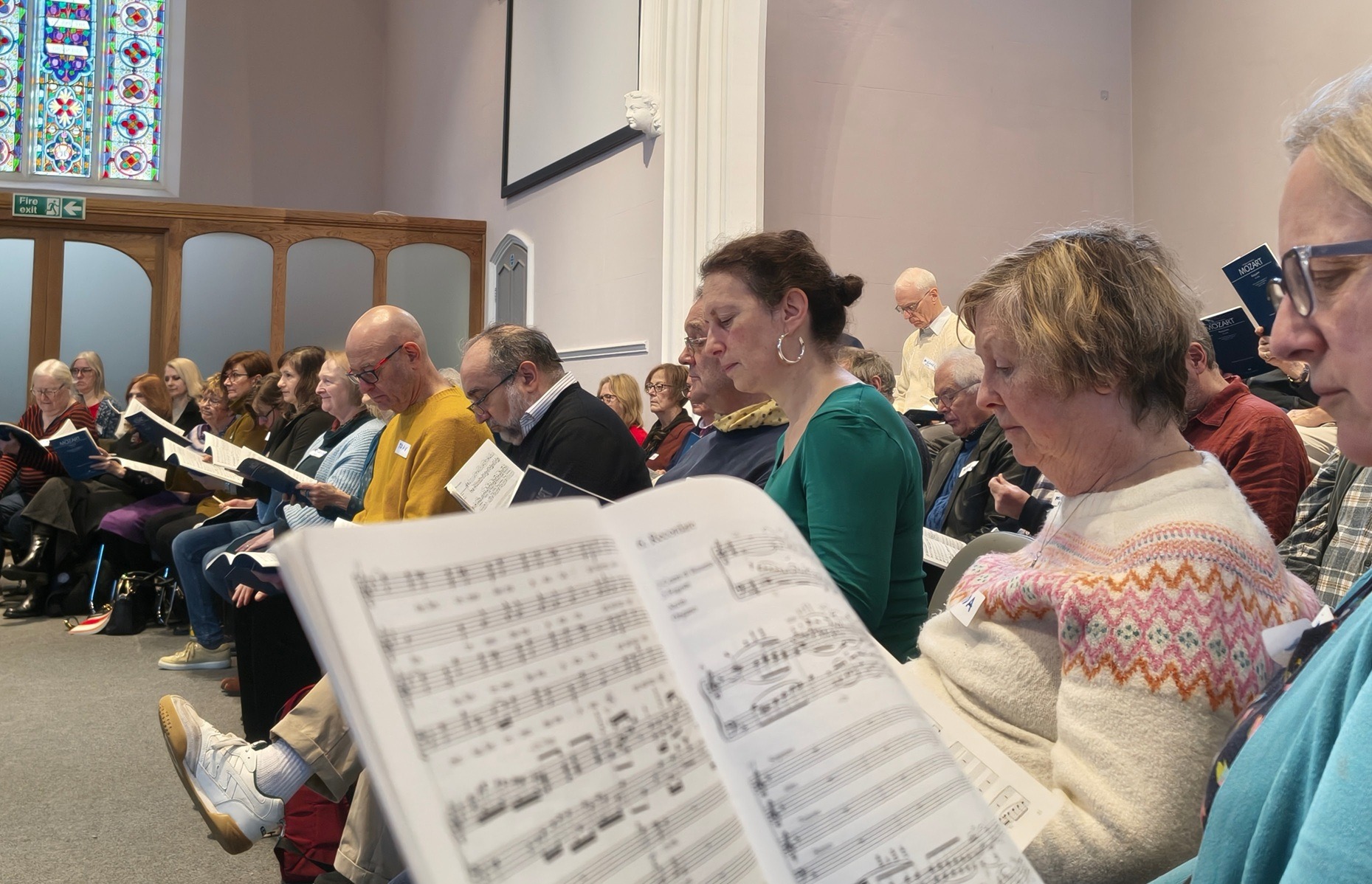
Yesterday’s open choral workshop brought together a wonderful group of singers to explore one of the most compelling works in the choral canon: Mozart’s Requiem. Under the theme “Mozart’s Requiem Revisited”, the day focused on Robert D Levin’s completion of the work, inviting us to listen, question, and sing with a fresh approach.
The workshop welcomed not only current members of our choir, but also patrons, former singers, friends from other local choirs, and participants who travelled from further afield. That mix of backgrounds and experiences created an atmosphere that was both open and energising — a shared curiosity united everyone in the room.
Expert Leadership and Engaged Music-Making
The workshop was led by Lloyd Buck, pianist and choral director from the Manchester area, whose thoughtful and engaging leadership set the tone for the day. Lloyd struck a fine balance between educating us about the history of the Requiem and its various completions, and involving everyone fully in the act of music-making. His clear direction, infectious enthusiasm, and ability to draw singers into the heart of the music ensured that energy and focus never waned.
Throughout the day, we were superbly supported by Iestyn Evans, a highly accomplished accompanist whose sensitive and assured playing underpinned every session. His musicianship gave singers confidence, clarity, and freedom to respond to Lloyd’s direction, and his contribution was central to the success of the workshop.
Why Revisit the Requiem?
Few choral works carry the weight of history, mystery, and emotional depth that Mozart’s Requiem does. Left unfinished at the composer’s death, it has long invited debate about authorship, authenticity, and intention. For many singers, the version completed by Franz Xaver Süssmayr is the one we know best — familiar, loved, and deeply ingrained.
Robert D Levin’s completion offers a thoughtful re-examination of the work, drawing on Mozart’s compositional habits, correcting known errors, and reimagining certain passages with clarity and stylistic confidence. Revisiting the Requiem through this lens challenges us not to discard tradition, but to engage with it more consciously.
Exploring Levin’s Completion
During the workshop, we explored key movements where Levin’s approach differs most noticeably, both musically and structurally. Singing these passages allowed participants to experience the differences from the inside — not just as listeners, but as active collaborators in the music.
Under Lloyd’s direction, the combined choir blended to produce a rich, confident sound, responsive and flexible, and capable of adapting quickly to new ideas and interpretations. What emerged was a deeper appreciation of Mozart’s voice and of the editorial decisions that shape the versions we perform today. Levin’s completion prompted lively discussion, thoughtful questions, and moments of genuine surprise.
A Shared Musical Experience
One of the most rewarding aspects of the day was the collective spirit in the room. Singers from different choirs and musical traditions quickly found common ground, listening closely to one another and responding as a single ensemble. That sense of shared exploration — learning not just what is different, but why it matters — lies at the heart of what choral workshops can offer.
For our own choir, it was also a pleasure to open our doors and make music alongside familiar faces and new ones alike. For many participants, the workshop provided a rare opportunity to sing this extraordinary work without the pressure of performance, focusing instead on understanding and discovery.
Looking Ahead
Revisiting Mozart’s Requiem in this way reminded us that great works remain alive precisely because they invite re-examination. Levin’s completion does not replace other versions, but sits alongside them, enriching our perspective and deepening our engagement with the music.
We are grateful to Lloyd Buck and Iestyn Evans for their inspiring leadership and musicianship, and to everyone who joined us — whether as a regular choir member, a returning singer, a supporter, or a visitor from another ensemble. Your enthusiasm, openness, and musical generosity made the day a success, and we look forward to welcoming many of you again soon.